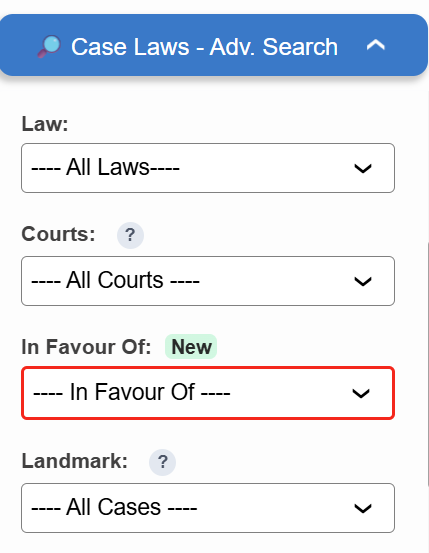
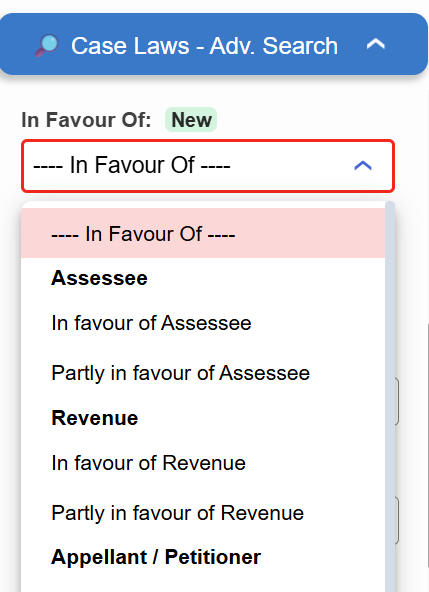
Introducing the “In Favour Of” filter in Case Laws.
- ⚖️ Instantly identify judgments decided in favour of the Assessee, Revenue, or Appellant
- 🔍 Narrow down results with higher precision
Try it now in Case Laws →
Just a moment...
Introducing the “In Favour Of” filter in Case Laws.
Try it now in Case Laws →

Press 'Enter' to add multiple search terms. Rules for Better Search
 of
of  of
of 


No Folders have been created
Are you sure you want to delete "My most important" ?
NOTE:
of of 
All Case Laws
of of All Case Laws

Note

Bookmark

Share


Don't have an account? Register Here
of <h1>Resolution Professional qualifies as public servant under Prevention of Corruption Act, discharge denied in money laundering case under Section 3 PMLA</h1> The Jharkhand HC dismissed the petitioner's discharge application in a money laundering case. The court held that a Resolution Professional qualifies as a ... Seeking grant of discharge/bail - Money Laundering - proceeds of crime - Resolution Professional is a public servant under Prevention of Corruption Act, 1988 or not - demand of bribe - all the conditions as stipulated under Section 3 of the PML Act, 2002 read with Section 2 (1) (u) of the PML Act, 2002 are satisfied or not - HELD THAT:- The “proceeds of crime” means any property derived or obtained, directly or indirectly, by any person as a result of criminal activity relating to a scheduled offence or the value of any such property or where such property is taken or held outside the country, then the property equivalent in value held within the country or abroad - In the explanation it has been referred that for removal of doubts, it is hereby clarified that 'proceeds of crime' include property not only derived or obtained from the scheduled offence but also any property which may directly or indirectly be derived or obtained as a result of any criminal activity relatable to the scheduled offence. The explanation has been inserted in the statute book by way of Act 23 of 2019. The reason for giving explanation under Section 2 (1) (u) is by way of clarification to the effect that whether as per the substantive provision of Section 2 (1) (u), the property derived or obtained, directly or indirectly, by any person as a result of criminal activity relating to a scheduled offence or the value of any such property or where such property is taken or held outside the country but by way of explanation the proceeds of crime has been given broader implication by including property not only derived or obtained from the scheduled offence but also any property which may directly or indirectly be derived or obtained as a result of any criminal activity relatable to the scheduled offence. It is settled connotation of law that at the stage of framing of charge, the probable defence of the accused is not to be considered and the materials, which are relevant for consideration, are the allegations made in the First Information Report/complaint, the statement of the witnesses recorded in course of investigation, the documents on which the prosecution relies and the report of investigation submitted by the prosecuting agency. The probative value of the defence is to be tested at the stage of trial and not at the stage of framing of charge and at the stage of framing of charge minute scrutiny of the evidence is not to be made and even on a very strong suspicion charges can be framed. The Hon'ble Apex Court in the case of Palwinder Singh Vs. Balvinder Singh & others [2008 (10) TMI 742 - SUPREME COURT] has been pleased to hold that charges can also be framed on the basis of strong suspicion. Marshaling and appreciation of the evidence is not in the domain of the court at that point of time. Further it is pertinent to mention here that power to discharge an accused was designed to prevent harassment to an innocent person by the arduous trial or the ordeal of prosecution. How that intention is to be achieved is reasonably clear in the section itself. The power has been entrusted to the Sessions Judge who brings to bear his knowledge and experience in criminal trials. Besides, he has the assistance of counsel for the accused and Public Prosecutor. He is required to hear both sides before framing any charge against the accused or for discharging him. Whether the evidence which has been collected in course of investigation and has been brought on record, as would be available in the impugned order prima facie case against the petitioner is made out or not? - HELD THAT:- Sub-section (v) of Section 2(c) of the Prevention of Corruption Act defines public servant. Further it is the nature of a duty, not an individual’s position, that discloses whether or not the person carrying it out is a public servant. Under the Prevention of Corruption Act the concept was to replace the notion of conventionally recognized public officials with those who carry out public duties - Further it is evident from the record that earlier the petitioner had preferred the Criminal Miscellaneous Petition being Cr.M.P. No. 1048 of 2021 for quashing of entire criminal proceeding arising out of the instant case, instituted against the petitioner including the F.I.R. being R.C.1(A)/2020-D, CBI, ACB, Dhanbad for the offence under Section 7 of Prevention of Corruption Act, 1988 by raising the similar ground which has been raised herein that petitioner is not a public servant within the meaning of Section 2(c) of the Prevention of Corruption Act, 1988 or under Section 21 of the IPC therefore charges under Prevention of Corruption Act cannot be alleged against him. The learned Single Judge of this Court has categorically held that Resolution Professional is made during the resolution process before the Company Law Tribunal with its approval, he will be a public servant under Section 2(c)(v) of the P.C. Act - This Court is of the view that since the duties performed by RP are public in nature, they are public servants and Sec 2(c) of Prevention of Corruption Act is pretty clear that an individual who performs public duties are public servants for the purpose of the Act and hence, the legislature would have felt that there are no explicit provisions are required. The ‘Resolution Professional’ will not come within the meaning of ‘Public Servant’ under Section 2 (c) of the PC Act is not tenable in the eyes of law. Discharge application - HELD THAT:- The expression “money-laundering”, ordinarily, means the process or activity of placement, layering and finally integrating the tainted property in the formal economy of the country. However, Section 3 has a wider reach. The offence, as defined, captures every process and activity in dealing with the proceeds of crime, directly or indirectly, and not limited to the happening of the final act of integration of tainted property in the formal economy to constitute an act of money-laundering. This is amply clear from the original provision, which has been further clarified by insertion of Explanation vide Finance (No. 2) Act, 2019, Section 3, as amended. The law regarding the approach to be adopted by the court while considering an application for discharge of the accused persons under Section 227 and approach while framing charges under Section 228 of the Code, is that while considering an application for discharge of the accused under Section 227 of the Code, the Court has to form a definite opinion, upon consideration of the record of the case and the documents submitted therewith, that there is not sufficient ground for proceeding against the accused. However, while framing charges, the Court is not required to form a definite opinion that the accused is guilty of committing an offence. The truth of the matter will come out when evidence is led during the trial. Once the facts and ingredients of the Section exist, the court would presume that there is ground to proceed against the accused and frame the charge accordingly and the Court would not doubt the case of the prosecution. It appears that the complaint contains material evidences for prosecution, thus, the petitioner has to prove her innocence by undergoing the trial therefore, the aforesaid contention of the learned counsel for the petitioner that the alleged money which has been allegedly trapped from this petitioner was under deemed custody of CBI (ACB), and the petitioner was never put in possession of the alleged cash, which is said to have been recovered from the possession of the petitioner, therefore alleged offence is not made out, cannot be adjudicated herein in the light of aforesaid discussion and settled position of law - there is no reason to believe by this Court that the petitioner is not involved in the alleged offence. This Court is of the view, that in such a grave nature of offence, which is available on the face of the material, applying the principle of discharge wherein the principle of having prima facie case is to be followed, the nature of allegation since is grave and as such, it is not a fit case to allow the application for discharge. Conclusion - i) A Resolution Professional, due to the nature of their duties, qualifies as a 'public servant' under the Prevention of Corruption Act, 1988. ii) The petitioner's actions, as alleged, constituted money laundering under Section 3 of the PMLA, given the acquisition and possession of proceeds of crime. iii) At the discharge stage, the court must assume the prosecution's evidence to be true and determine if a prima facie case exists, without delving into the probative value of the evidence. The petitioner's application for discharge dismissed. 1. ISSUES PRESENTED and CONSIDEREDThe core legal issues considered in this judgment include:(a) Whether the petitioner, acting as a Resolution Professional (RP) under the Insolvency and Bankruptcy Code, 2016, qualifies as a 'public servant' under the Prevention of Corruption Act, 1988.(b) Whether the petitioner was rightly charged under Section 3 of the Prevention of Money Laundering Act, 2002 (PMLA) for allegedly accepting a bribe, thus engaging in money laundering activities.(c) Whether the trial court's decision to dismiss the petitioner's discharge application was justified based on the evidence presented.2. ISSUE-WISE DETAILED ANALYSIS(a) Qualification as a 'Public Servant':- Relevant Legal Framework and Precedents: The Prevention of Corruption Act, 1988 defines 'public servant' under Section 2(c). The court examined whether a Resolution Professional (RP) falls within this definition. The court referred to prior judgments, including the decision in Cr.M.P. No. 1048 of 2021, which held that RPs perform functions akin to public duties.- Court's Interpretation and Reasoning: The court reasoned that the nature of duties performed by an RP involves public interest, thereby qualifying them as public servants under the Prevention of Corruption Act. The court emphasized that the definition of 'public servant' is broad and includes those performing public duties, even if they are not directly employed by the government.- Key Evidence and Findings: The court relied on the duties and responsibilities of an RP as outlined in the Insolvency and Bankruptcy Code, 2016, which involve managing corporate insolvency resolution processes, thereby impacting public interest.- Conclusions: The court concluded that the petitioner, as an RP, is a public servant under the Prevention of Corruption Act, 1988.(b) Charges under PMLA:- Relevant Legal Framework and Precedents: Section 3 of the PMLA defines the offense of money laundering, which includes activities related to the proceeds of crime, such as concealment, possession, acquisition, and use.- Court's Interpretation and Reasoning: The court noted that the petitioner was allegedly caught accepting a bribe, which constitutes proceeds of crime under the PMLA. The court emphasized that the PMLA captures every process or activity connected with proceeds of crime, not just the final act of integration into the formal economy.- Key Evidence and Findings: Evidence presented included a recorded conversation and the recovery of bribe money from the petitioner. The prosecution argued that the petitioner knowingly acquired and possessed proceeds of crime.- Application of Law to Facts: The court applied the definition of 'proceeds of crime' and found that the petitioner's actions fell within the scope of money laundering under Section 3 of the PMLA.- Treatment of Competing Arguments: The petitioner argued that the bribe money was not in his possession due to the CBI's trap operation. The court dismissed this argument, emphasizing that possession and acquisition of proceeds of crime are sufficient for charges under the PMLA.- Conclusions: The court concluded that there was sufficient evidence to proceed with charges under Section 3 of the PMLA against the petitioner.(c) Dismissal of Discharge Application:- Relevant Legal Framework and Precedents: The court referred to legal principles governing discharge applications, emphasizing that at this stage, the court must assume the prosecution's evidence to be true and determine if a prima facie case exists.- Court's Interpretation and Reasoning: The court reasoned that the evidence presented by the prosecution, including witness statements and documentary evidence, established a prima facie case against the petitioner.- Key Evidence and Findings: The court highlighted the recovery of bribe money and the petitioner's admissions during the investigation as evidence supporting the charges.- Application of Law to Facts: The court applied the principles of discharge, noting that the evidence presented was sufficient to presume the commission of the offense, warranting a trial.- Treatment of Competing Arguments: The petitioner argued that the evidence was insufficient for conviction. The court clarified that the probative value of evidence is not assessed at the discharge stage.- Conclusions: The court upheld the trial court's decision to dismiss the discharge application, allowing the trial to proceed.3. SIGNIFICANT HOLDINGS- The court held that a Resolution Professional, due to the nature of their duties, qualifies as a 'public servant' under the Prevention of Corruption Act, 1988.- The court established that the petitioner's actions, as alleged, constituted money laundering under Section 3 of the PMLA, given the acquisition and possession of proceeds of crime.- The court affirmed the principle that at the discharge stage, the court must assume the prosecution's evidence to be true and determine if a prima facie case exists, without delving into the probative value of the evidence.- The court dismissed the petitioner's application for discharge, allowing the trial to proceed based on the evidence presented.
 TaxTMI
  TaxTMI
  TaxTMI
