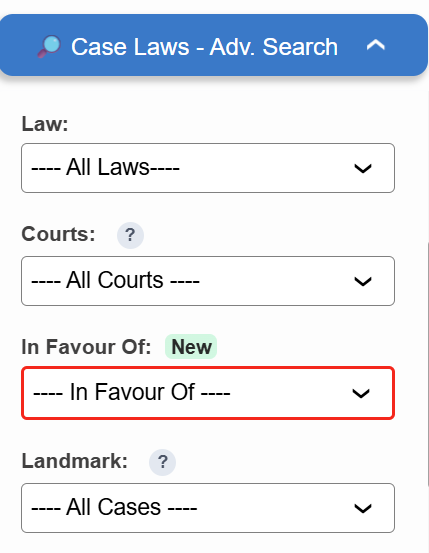
Introducing the “In Favour Of” filter in Case Laws.
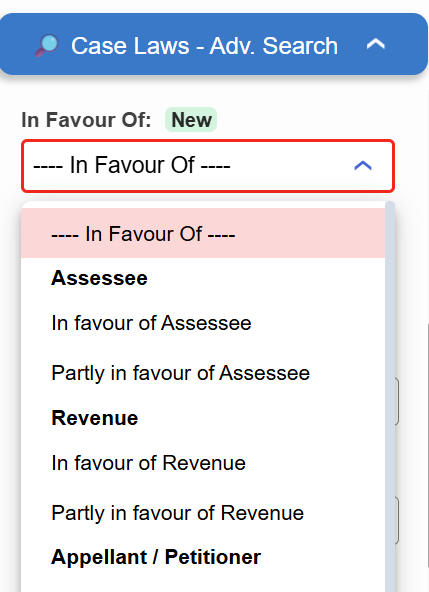
- ⚖️ Instantly identify judgments decided in favour of the Assessee, Revenue, or Appellant
- 🔍 Narrow down results with higher precision
Try it now in Case Laws →
Just a moment...
Introducing the “In Favour Of” filter in Case Laws.
Try it now in Case Laws →

Press 'Enter' to add multiple search terms. Rules for Better Search
 of
of  of
of 


No Folders have been created
Are you sure you want to delete "My most important" ?
NOTE:
of of 
All Case Laws
of of All Case Laws

Note

Bookmark

Share


Don't have an account? Register Here
of <h1>Petition against Tax Officer's Jurisdiction Dismissed; Court Emphasizes Exhausting Remedies Before Seeking Judicial Help.</h1> The HC dismissed the petition challenging the Income Tax Officer's jurisdiction under Section 148A(d) of the Income Tax Act, ruling that the petitioner ... Reopening of assessment u/s 147 - reasons to believe - department received information that the value of land, which was subject matter of transaction of sale, was far more than what has been disclosed - HELD THAT:- It appears to be a case where the department has collected certain information regarding certain income having escaped assessment. Whether or not, the information is reliable, would be required to be examined at subsequent stages and at this stage, the writ court would not go into the disputed questions of facts pertaining to valuation of the land or the nature of the land. As decided by SC in Anshul Jain [2022 (10) TMI 3 - SC ORDER] What is challenged before the High Court was the re-opening notice under Section 148A(d) of the Income Tax Act, 1961. The notices have been issued, after considering the objections raised by the petitioner. If the petitioner has any grievance on merits thereafter, the same has to be agitated before the Assessing Officer in the re-assessment proceedings. Under the circumstances, the High Court has rightly dismissed the writ petition. In view of above settled legal position, in the factual premise of the case, which has led to passing of the impugned order under Section 148A(d), we are not inclined to interfere in the matter but leave the petitioner to work out his remedy in the proceedings subsequent to issuance of notice under Section 148 of the Income Tax Act. Petition dismissed. Issues:1. Jurisdiction of the Income Tax Officer under Section 148A(d) of the Income Tax Act.2. Allegations of income escaping assessment due to undervaluation of land in a sale deed.3. Procedural impropriety in initiating proceedings under Section 148.4. Whether the court should intervene at the notice stage under Section 148.Analysis:1. The petitioner challenged the order passed by the Income Tax Officer under Section 148A(d) of the Income Tax Act, contending that the proceedings under Section 148 were without jurisdiction. The petitioner argued that the disclosed income from a land sale was accurate, and no income had escaped assessment. The Revenue, on the other hand, asserted that the issue raised was not about jurisdiction but a matter for determination after the notice under Section 148. The court found no procedural irregularities or violations in the initiation of proceedings, emphasizing that the information regarding potential income escaping assessment required further examination.2. The court referred to a case where the High Court of Punjab and Haryana addressed a similar issue, highlighting the debate on whether the court should delve into the merits of the controversy at the notice stage under Section 148. Previous judgments emphasized that challenging an Income Tax Officer's actions through writs was not permissible, as the Act provided a comprehensive mechanism for assessment and reassessment. The court noted that it was premature to quash the notice under Section 148 at this stage, leaving the petitioner to pursue remedies during subsequent proceedings.3. Citing various precedents, including the Supreme Court, the court reiterated that interference by the writ court at a premature stage of ongoing proceedings was unwarranted. The court emphasized the distinction between jurisdictional errors and errors within jurisdiction, stating that statutory remedies existed for rectification. The Supreme Court's dismissal of a Special Leave Petition against a similar order further supported the position that challenging the re-opening notice under Section 148A(d) should be done during reassessment proceedings before the Assessing Officer.4. Ultimately, the court dismissed the petition based on the settled legal position and factual circumstances, indicating that the petitioner should address any grievances on merits during the reassessment proceedings. The court declined to interfere, emphasizing that the petitioner could pursue remedies after the issuance of the notice under Section 148 of the Income Tax Act. The judgment highlighted the importance of following the statutory procedures and exhausting available remedies within the established framework of the Act.
 TaxTMI
  TaxTMI
  TaxTMI
